Hair thinning has a way of feeling deeply personal.
One day, you’re casually brushing your hair. The next, you’re staring at the sink, the shower drain, your hairbrush, and possibly your entire life with suspicion.
And the frustrating part? Hair thinning rarely comes with one neat explanation tied up in a little silk ribbon.
For women, hair loss can be connected to so many different things: hormones, perimenopause, menopause, stress, thyroid issues, iron deficiency, postpartum changes, genetics, nutrition, illness, and even certain medications. The rise in GLP-1 weight-loss drugs has also been associated with increased concern about shedding. Around one-third of women experience hair loss at some point in their lives, and for some, the first signs can appear as early as their thirties.
In other words, hair thinning is not always a “just buy a serum” situation. It’s usually more complicated than that.
Which is why persistent, sudden, or unexplained shedding is worth paying attention to before assuming a cosmetic product can solve everything. Sometimes the real answer starts with bloodwork, a doctor’s visit, or figuring out what changed behind the scenes.
That said, the beauty world has definitely started paying more attention to female hair loss. And honestly? It’s about time.
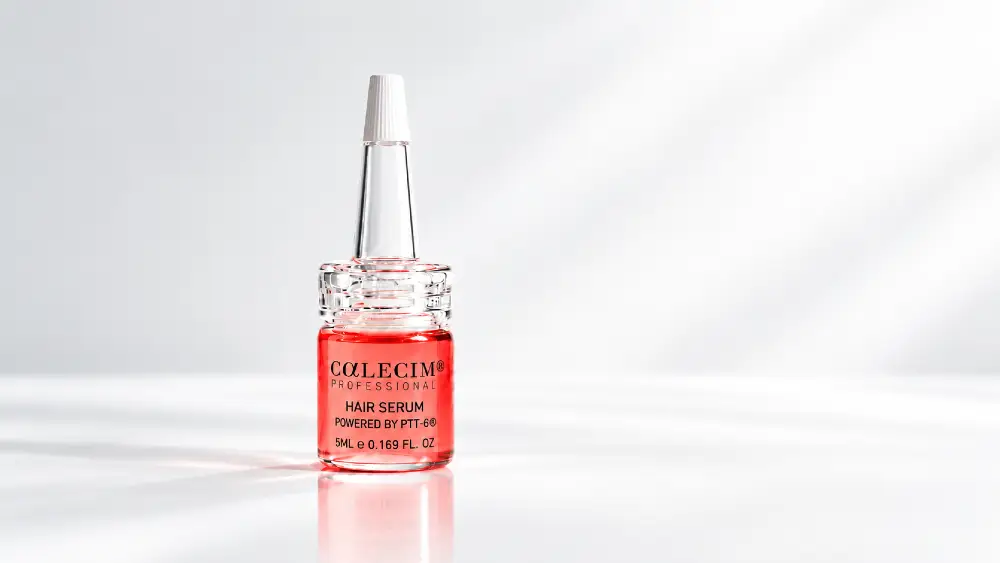
One treatment getting more attention is the Calecim Professional Advanced Hair System, a six-week at-home program built around a topical hair serum. With a price close to $360 (£300), it is very much not an impulse purchase you toss into your cart between lip balm and dry shampoo.
So the real question is: does Calecim stem cell serum actually work for hair growth?
The short answer: the early observations are promising, but this is not something I’d treat as a guaranteed fix for every type of hair loss.
Let’s get into it.
What makes Calecim different?
The main ingredient Calecim highlights is its proprietary PTT-6® technology.
According to the brand, PTT-6® contains more than 3,000 proteins, including regenerative growth factors, exosomes, and stem cells derived from the umbilical cord lining of red deer. That is a sentence that sounds like it belongs somewhere between a dermatology conference and a very expensive facial.
Originally developed for wound repair, the ingredient is now being used in Calecim’s approach to scalp and hair care. The idea is that these active components may help support the scalp environment and encourage healthier-looking hair growth.
Calecim also claims the formula may help reduce scalp inflammation, which can be relevant because inflammation can play a role in shedding and overall scalp health.
This is why the product is often discussed using the language of stem cell technology, growth factors, and regenerative skincare.
But here’s where I’d stay grounded: this does not mean it is a guaranteed answer for every person dealing with thinning hair. Hair loss has too many possible causes for any one serum to be treated like a universal solution.
Frustrating? Yes.
Important? Also yes.
What results have been observed?
Calecim says users may notice visible changes in as little as six weeks, which lines up with the initial treatment period.
Dr. Manav Bawa, an aesthetic physician and medical director of the Time Clinic in London, has also reported that many of his clients begin noticing a difference around that six-week mark.
He has been conducting trials involving 12 perimenopausal patients between the ages of 37 and 54, each with mild to moderate hair loss. While that is a small group and the work is still ongoing, he has said that he has observed a difference in every patient assessed so far.
Other clinical observations cited by the brand reported:
- a 14% increase in the number of hair follicles on the scalp
- a 16% increase in hair-shaft thickness
- a 15% increase in the number of follicles per square centimeter of scalp
Those numbers are much more helpful than the usual beauty-brand promise of “fuller-looking hair,” which can sometimes mean everything and nothing at the same time.
Still, they should be read as encouraging clinical observations, not a guarantee that every person will see the same result.
The cause of your hair loss matters. The severity matters. Your hormones, health, scalp condition, and consistency all matter too.
Hair, unfortunately, loves context.
Why thickness matters too
When people think about hair growth, they usually focus on new hair.
And yes, new growth matters.
But the appearance of fuller hair is not just about the number of hairs on your head. It also depends on the thickness and density of the hair you already have.
That’s why the reported increase in hair-shaft thickness is interesting.
For many women, the problem is not always dramatic bald patches. Sometimes it’s a widening part. A ponytail that feels smaller. Hair that suddenly looks less substantial. Volume that used to be there and now seems to have quietly moved out without leaving a forwarding address.
So if a treatment helps improve the look or feel of thickness, that can be meaningful even if someone is not counting every single new hair.
Patient feedback reported by Bawa reflects this. Some women said they felt more confident, while hairdressers and friends commented that their hair looked thicker and healthier.
That kind of feedback is subjective, of course. It is not the same as clinical measurement.
But if you have ever felt self-conscious about thinning hair, you know that visible improvement, even subtle improvement, can feel like a very big deal.
Is six weeks long enough to know if it works?
Six weeks is the earliest point where some users may start to notice a difference. It is not a promise that everyone will have a complete transformation in six weeks.
That distinction matters. However, that is still shorter than the 12 weeks I’ve experienced with popular brands like Vegamour and Rogaine.
The fact that Calecim recommends weekly maintenance after the initial phase also suggests this is designed as an ongoing routine, not a one-and-done treatment where you use it for six weeks and then ride off into the sunset with permanently thicker hair.
So before investing, it’s worth asking yourself two things:
- Can I commit to the routine?
- And can I commit to the cost?
Because a product can be scientifically interesting and still not be practical for everyone. If a treatment only works with consistency, then the real question becomes whether it fits into your actual life.
Not your fantasy life. Your real one.
The one with laundry, errands, late nights, and a bathroom counter that may already be emotionally overcrowded.
Who might be interested in Calecim hair serum?
Based on the information available, Calecim may be most appealing for men and women dealing with mild to moderate thinning who want an at-home treatment option and are interested in newer beauty-science ingredients like growth factors and exosomes.
It may be especially interesting for women noticing:
- a widening part
- reduced density
- thinner-looking hair
- less volume
- early signs of hormonal hair changes
- mild to moderate shedding
- hair that looks less substantial than it used to
But again, if your hair loss is sudden, severe, patchy, or unexplained, that is a different situation. In those cases, it is worth speaking with a healthcare provider or dermatologist before investing in a topical product.
A serum may help support the scalp and hair, but it cannot diagnose why your hair is shedding in the first place.
And that “why” matters.
So, does Calecim stem cell serum work?
The most balanced answer is: there are encouraging signs.
The clinical observations cited by the brand show measurable improvements in areas connected to fuller-looking hair, including follicle count, hair-shaft thickness, and follicle density. Dr. Bawa’s early work with perimenopausal patients has also produced positive observations so far.
That is promising.
But I would still frame Calecim as a structured at-home hair treatment supported by early clinical observations, not as a guaranteed cure for thinning hair.
For someone considering the investment, the decision really comes down to three things: the evidence,
the cost, and the willingness to stay consistent.
If you are dealing with hair thinning and already understand the likely cause, Calecim may be worth considering as part of a longer-term hair-care plan.
If you do not yet know why your hair is thinning, I’d start there first. Because sometimes the most important beauty trial is not the product. It’s figuring out what your body has been trying to tell you.
This post is sponsored by Calecim Professional.


